
What’s the Story?
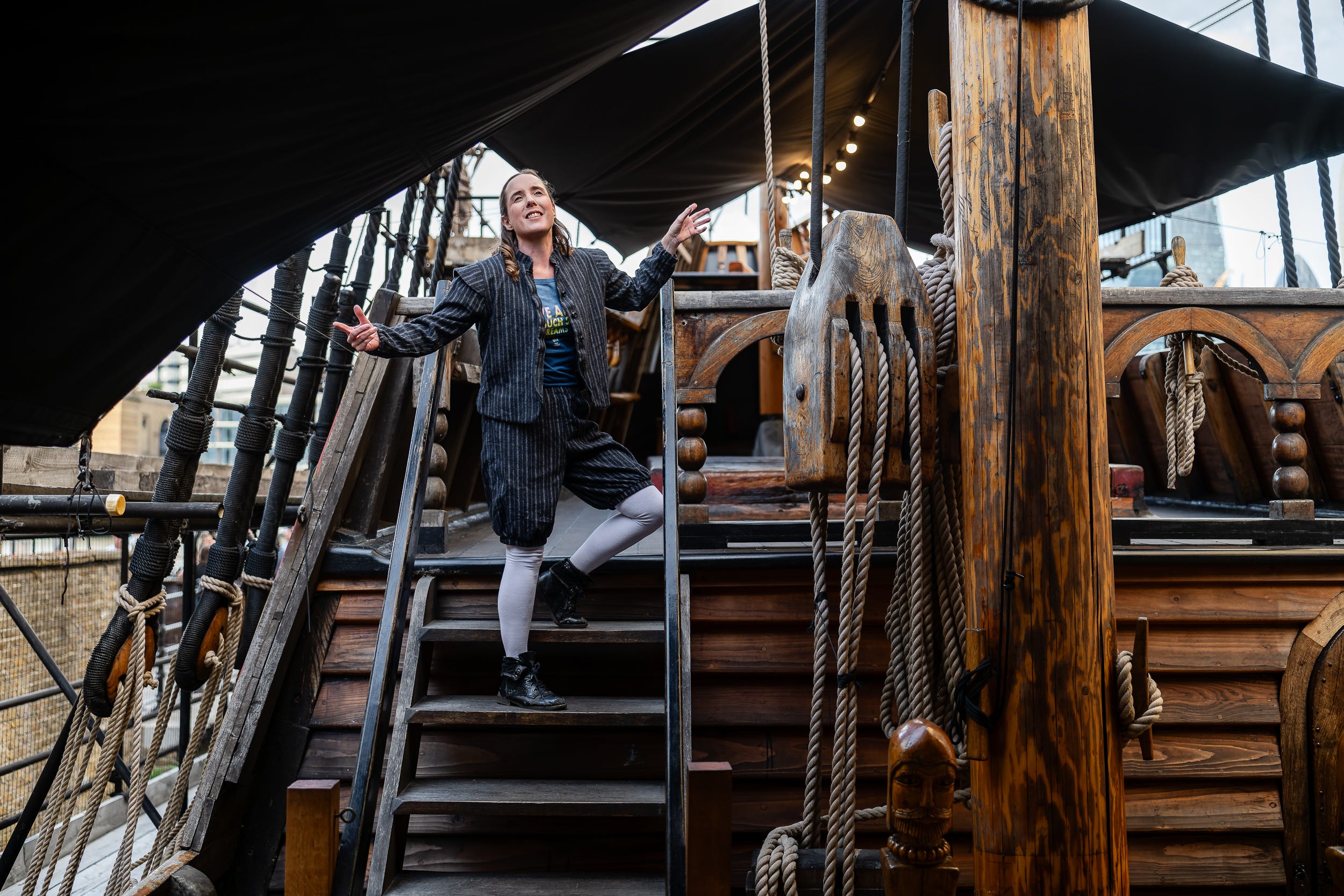
There can be few more enticing places to stage The Tempest than aboard The Golden Hinde. Moored beside the Thames on London’s Bankside, the reconstructed Elizabethan galleon provides something no conventional set could quite replicate: real timbers beneath your feet, cramped cabins, steep ladders, low beams and the irresistible feeling that you have stepped aboard something built and bound for another world.
For this site-specific production, Shakespeare’s sprawling tale of shipwreck, magic, betrayal, revenge and reconciliation has been condensed into approximately 60 minutes, performed by a cast of six. Both actors and audience travel through different levels of the ship, as Prospero’s enemies find themselves at the mercy of his magic.
It’s a daring proposition. At times, though, the setting proves a little more compelling than the play unfolding within it.
What Surprised Me?
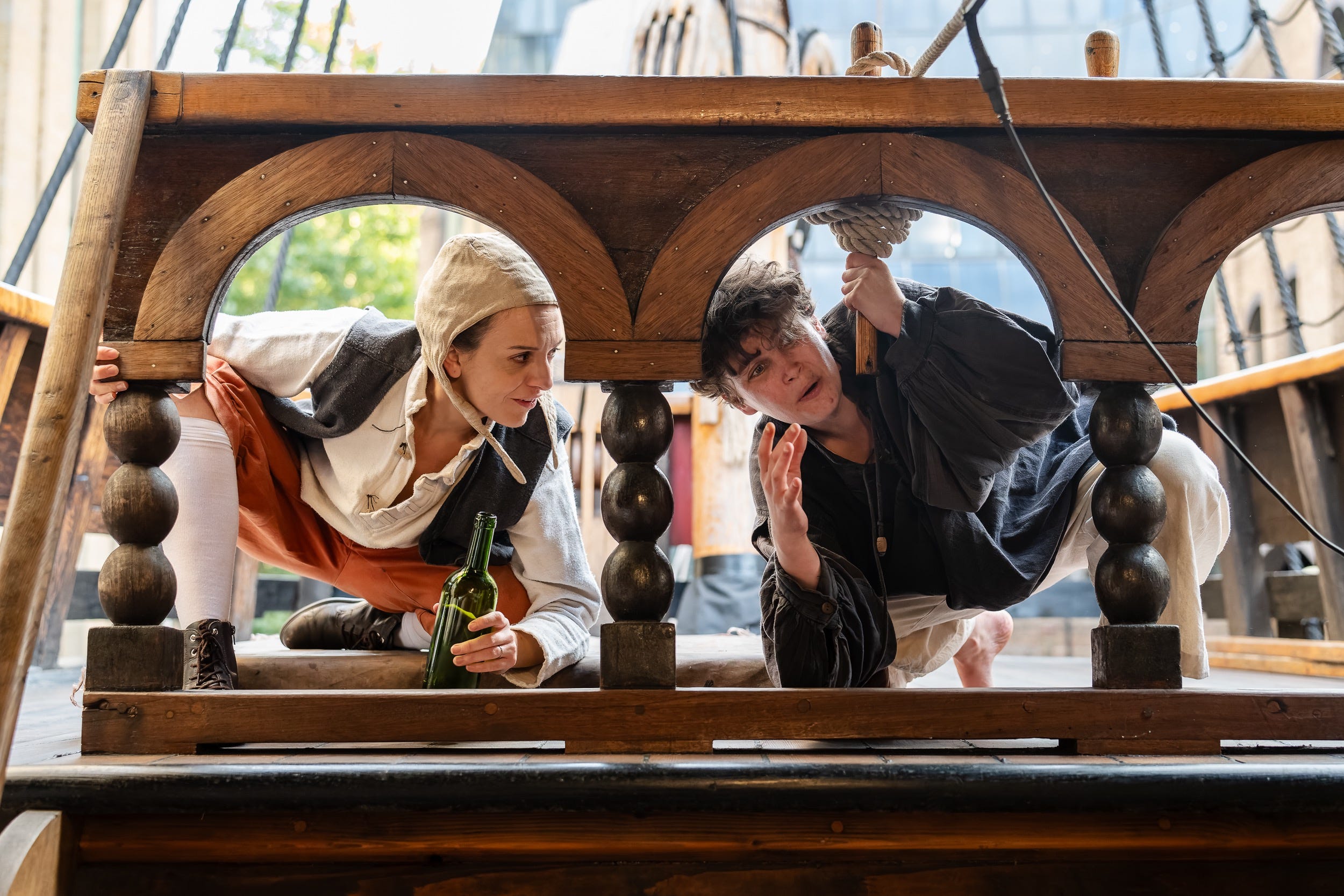
The most successful idea of the evening is also one of the simplest: we don’t stay put. The audience is shepherded up ladders, through narrow spaces and between decks, following the story around the ship. At one point we’re divided into two groups, each watching a different scene before swapping places.
The surprise, when it comes to moving a disparate group of audience members, is that it all works beautifully - no cat-herding comparisons to be made here!
There’s something immediately bonding about squeezing into a tiny space together with a fellow band of adventurers to discover what is happening there – and the smaller groups create an intimacy between actors and spectators which suits the production very well.

What Worked?
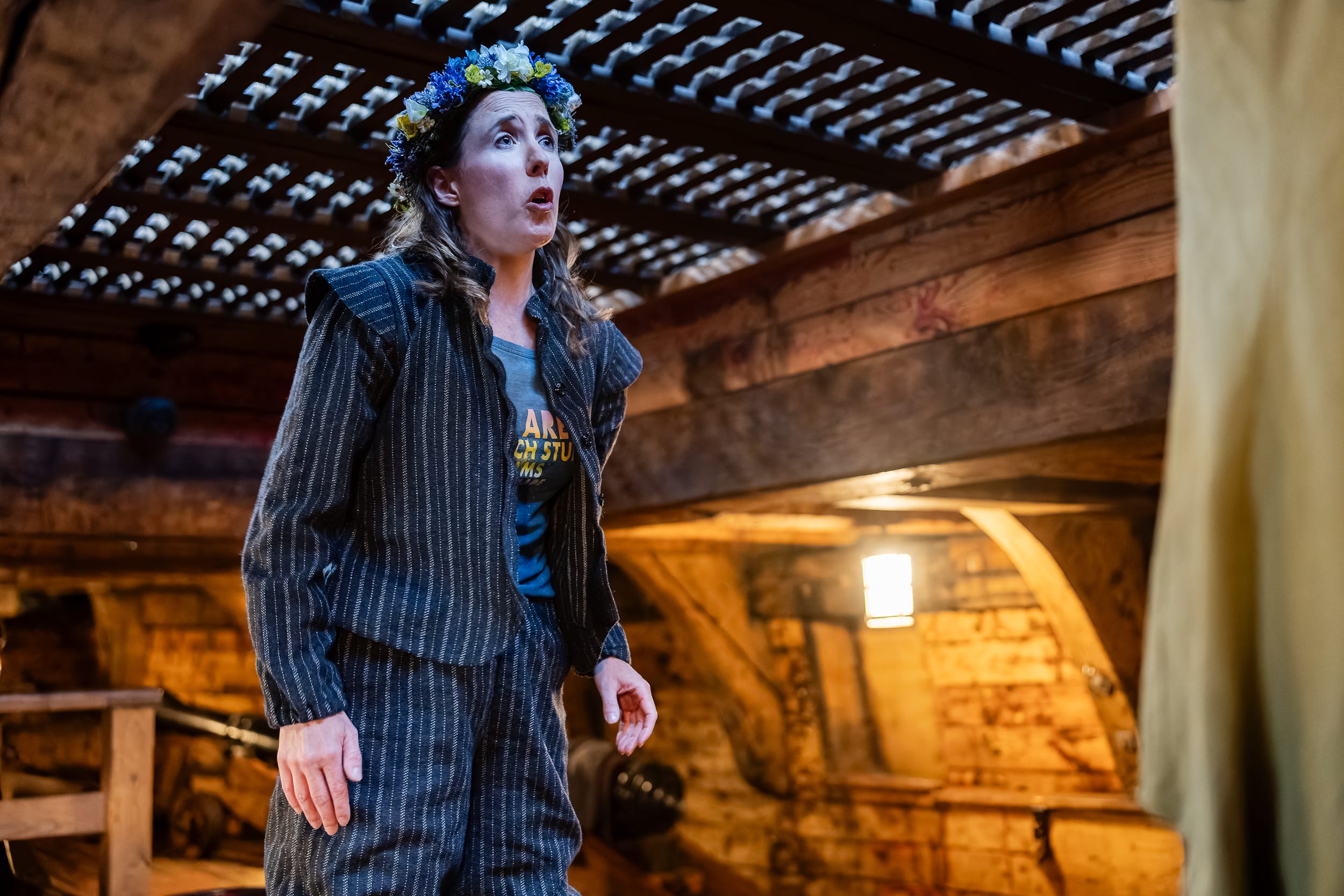
Cassandra Wilson is particularly impressive in the dual roles of Ariel and Miranda. Her two characters are delightfully physically and vocally distinct. Take away Shakespeare’s words and the costume signifiers and there would still be little doubt which character she was playing. In a production relying heavily on multi-roling, that precision matters. Charlie Woodward also brings a likeable sincerity to Ferdinand, while Lauren Grierson creates some enjoyable comic moments as Stephano.
Simple costume choices generally help us keep track of changing characters, while the Golden Hinde itself does much of the designers’ work for them. There’s little need to suggest a maritime world when we’re crouching beneath actual wooden beams.
The soundscape adds another layer, helping to create the illusion that this stationary ship might somehow have slipped its moorings.
The company as a whole also deserves considerable credit for the sheer physical challenge of performing here. Low ceilings, unforgiving beams, narrow stairways and steep ladders would complicate simply walking around the ship; incorporating them into a performance while an audience occupies the same spaces is another matter entirely.
Room for Improvement?
The impressively managed movement around the ship does come with an inevitable trade-off. A surprisingly substantial proportion of a 60-minute show is spent relocating its audience. Atmospheric as the journey is, I wondered how much more breathing room the play might have gained from fewer moves.
Reducing The Tempest to an hour is an enormous challenge. This version necessarily strips away great swathes of plot and character development. Those already familiar with Shakespeare’s play can fill in the gaps. I’m not so certain that a newcomer could.
The multi-roling occasionally adds to that confusion when the distinction between characters isn’t sufficiently strong. Sightlines can also be problematic: one exchange between Prospero and Miranda positions the pair opposite one another, leaving those seated behind Miranda looking predominantly at her back. In a space where visibility is already restricted, positioning becomes especially important.
Sound occasionally competes with rather than supports the actors. The production can’t control the considerable ambient noise of Bankside, but there were also a few moments when the show’s own soundscape made already difficult-to-hear dialogue harder still.

And the Award Goes To…
The Golden Hinde. The great achievement of this Tempest is the experience it creates around Shakespeare’s play: boarding after hours, ducking beneath beams, following Ariel into another compartment, squeezing alongside strangers and wondering where the story will take us next.
And perhaps there’s a great lesson in that for independent theatre-makers. A limited budget needn’t mean a limited theatrical imagination. Sometimes the most exciting piece of design available to you is finding somewhere extraordinary and asking: could we tell a story here?
In condensing the play so drastically, this production sacrifices a little too much clarity and character depth for it to fulfil all of its promise. But as an experiment in putting Shakespeare somewhere he isn’t usually found, it has genuine magic. I left wanting more - more space for the story to breathe, and more theatre-makers willing to look beyond conventional stages and imagine what might happen elsewhere. Just remember to mind your head!
🎭