
Picasso Pablo Ruiz – Spanish poet
who dabbled in painting, drawing
and sculpture.
– Picasso (1971)
Desire Caught by the Tail: The Paris 1944 Reading
Desire Caught by the Tail would be fiendishly difficult to put on, though it has been, multiple times. The first performance was a reading, enabling the audience to use their imaginations. It took place in Michel Leiris’s apartment overlooking the Seine. The director, actors and audience were a who’s who of the Parisian avant-garde intelligentsia.
Michel Leiris and Picasso were old friends. Leiris was a brilliant man and a well-known writer and ethnographer. Picasso enjoyed bouncing ideas off him on art and writing. Leiris was legendary for his bouts of drinking. His appearance was striking, a very large head atop a very small body. He would put on a cordial smile and then as suddenly switch it off. Most people found him intimidating. Despite their closeness, Picasso never drew him.
Leiris’s wife Louise – known as Zette – was the stepdaughter of Picasso’s long-time agent Daniel-Henry Kahnweiler. From time to time Kahnweiler hid from the Nazis in Leiris’s apartment.
Leiris contacted the most radical and brilliant of the Parisian avant-garde intellectuals to read and direct.
Albert Camus, who had theatrical experience, directed the play and rehearsed the actors. With his trench coat and cigarette dangling from clenched lips he was the poster boy of French philosophy, basking in the fame of his books, The Stranger and The Myth of Sisyphus, which had slipped through the net of Nazi censorship. For Camus, living life to its fullest in the face of the Occupation was a way to defeat it. In 1943 he joined the Resistance newspaper Combat, and was its editor-in-chief from 1944 to 1947. He met Picasso in that melting pot of French intelligentsia, Café de Flore on Boulevard St. Germain.
Leiris played the lead part of Big Foot and Zette The Two Bow Wows. The Tart was played by the beautiful young actress Zanie de Campan, wife of the editor Jean Aubier who played The Curtains. Dora Maar, the photographer who was also Picasso’s mistress, took the role of Thin Anxiety.
Simone de Beauvoir and Jean-Paul Sartre, the golden couple of philosophy, had met Leiris at Café de Flore. She took the role of Her Cousin, while Sartre played Round Piece.
Jacques-Laurent Bost was a journalist, screenwriter and translator who had been having an affair with de Beauvoir for six years. She considered Bost a close second to Sartre and continued to be involved with him to the end of her life. Leiris enlisted him to play Silence.
Germaine Hugnet, who played Fat Anxiety, was a French gallery director and a central figure in the Parisian avant-garde. She was the wife of the surrealist poet Georges Hugnet and lover of the French painter and sculptor André Beaudin. Georges was in charge of music at the reading. He played records in another room.
Raymond Queneau, who befriended Picasso and Leiris at Café de Flore, played The Onion. He was a poet, critic, editor and songwriter.
Five or six rehearsals took place which Picasso occasionally attended. Before one, Leiris left a note in Picasso’s studio: “Dear Friend, We are at the house with the beaver [le Castor], Casarès, Sartre and Camus. We would be delighted if you could come over.”1 “The beaver” was Sartre’s affectionate nickname for de Beauvoir, playing on her name and her hard work and energy.
Camus met Maria Casarès, an actress and the love of his life, during rehearsals of Picasso’s play. His correspondence with Maria is extensive and heart rending: he often wrote to her twice a day. In 1960 he was killed in a car accident, on his way to Paris for a reunion with her.
The Reading
There were several rows of chairs set up but they were quickly occupied and many stood in the cramped room. The audience included Picasso’s colleague and friend Georges Braque whom de Beauvoir described as “very good looking”; the psychiatrist Jacques Lacan, whom Picasso would advise Dora Maar to see after their break up; the poet Pierre Reverdy, who frequented le Bateau Lavoir and whose poetry influenced modernism; and Jean Cocteau, poet, playwright, novelist, designer, film director, visual artist and critic, and on and off friend of Picasso.
At seven o’clock, Camus commenced the performance with three sharp taps of a walking stick. He repeated this at the start of each scene and explained the stage directions which the audience were left to imagine, as well as introducing the characters. The actors stood with their backs to the wall which had windows facing onto the Seine. Camus had rehearsed them well. The performance lasted for about an hour.
In Big Foot’s final speech Picasso seems to be asking, why has there as yet been no uprising? Or perhaps he was asking the Resistance members in the audience to get a move on? In a sense the play was in itself an uprising. At the end we can imagine everyone rising to sing “La Marseillaise,” sotto voce, of course.
Everyone’s spirits were lifted by the gathering. The women took the occasion to dress to the nines, ingeniously embellishing their drab Occupation attire. Picasso complimented them all. This was the first time in a long long time that so many people were glad to be alive and having a noisy frivolous time. It was a victory.
By eleven most of the remaining guests had departed. The Leirises convinced the performers and a few close friends to stay on. The party went on till five in the morning when the curfew was lifted. Leiris played jazz. Sartre played the piano and sang Les Papillons de nuit [Butterflies of the night] and J’ai vendu mon âme au diable [I have sold my soul to the devil]. Camus, ever the ladies’ man and the best dancer of the group, took to the floor. Camus and Leiris read scenes from a favourite novel and others chimed in with their choices. De Beauvoir recalled that never in her life had she had so much fun. She realised ruefully that the next day it was back to work.
The Aftermath
Opinions were complimentary. In a letter to Picasso on 22 March 1944, Valentine Hugo, a surrealist artist and writer, divorced from Jean Hugo, Victor Hugo’s great grandson, wrote that the 1944 reading left her “spellbound.”
She was amazed at the ease with which Picasso could shift areas of interest and create new and fresh forms. “You write a play and suddenly all the others are shifted to another plane….[L]ike everything you do – the experiment is made….The success is unique – any imitation or follow up will be a failure.”2
On 16 June 1944 Picasso invited the cast and some audience members to his studio. It had been a long afternoon and some people had left by the time Picasso’s friend, the photographer, Brassaï, suggested he take a photograph which immortalised the 1944 reading.3
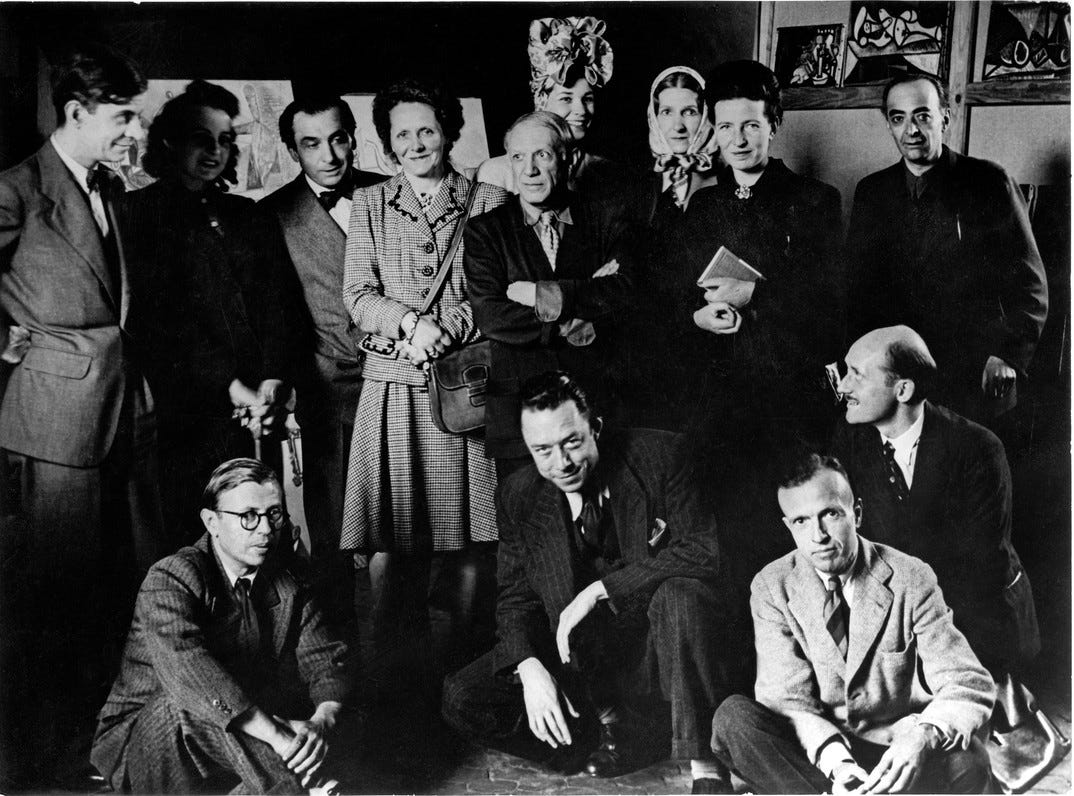
Staging: Desire Caught by the Tail
Since that first reading there have been several notable productions. The closest to the text was the first French staging which took place in St. Tropez in 1967. This over the top production took some artistic liberties with Picasso’s original conception, stage directions and all. As an indication of how subversive it was, the mayor shut it down before the curtain went up. He objected to the scene where The Tart urinates on stage for ten minutes. The purity of his city must be maintained, he said. He may well have suspected that there would be problems when he heard that the director was Jean-Jacques Lebel, the king of European Happenings. Ironically the production was supposed to be part of the town’s annual Festival of Free Expression.
So Lebel set up a circus tent big enough for 800 spectators outside the city’s limits. The place was packed. The actress Marnie Cabanetos, playing The Tart, took to the stage and immediately shed her transparent plastic raincoat. Clad only in net stockings she pranced around to the beat of Soft Machine. The décor was garish, framed with electrical displays.
As for the scene that was the root cause of all the trouble, The Tart squatted to the soundtrack of a gurgling waterfall. Lebel insisted that he had to keep that scene. As he said, we cannot “emasculate a work of art in order to pander to bourgeois sentiment.”
The stripper Rita Renoir took the role of Thin Anxiety in the briefest of bikinis. The cast also contained two of Andy Warhol’s “superstars:” Taylor Mead played The Two Bow Wows and Ultra Violet The Curtains. Salvador Dalí helped her obtain the role. The play was a psychedelic multimedia Happening and the audience loved it.
There have been other productions including a reading in 1950 in which Dylan Thomas directed and took the part of The Onion. There was also a production off-Broadway in New York in 1969 in which a very young Sylvester Stallone wore red horns, a scarlet fright wig in his groin and a huge fake penis. Other productions have featured luminaries such as David Hockney and Louise Bourgeois.
Picasso would have been pleased to find his play writing skills – and his play – still celebrated.
Two years before his death in 1971, Picasso told Miguel Acoca of the International Herald Tribune, that he would like to be remembered as: “Picasso Pablo Ruiz – Spanish poet who dabbled in painting, drawing and sculpture.”
🎭
Read Arthur I. Miller’s biography at the end of Part 1.
Centre d’Études Picasso, File, LEIRIS, MICHEL, 515AP/C/2341 to 2344.
Centre d’Études Picasso, File, HUGO, VALENTINE, 515AP/C/64.
Standing, left to right: Jacques Lacan, Cécile Éluard, Pierre Reverdy, Louise (Zette) Leiris, Pablo Picasso, Zanie de Campan, Valentine Hugo, Simone de Beauvoir, and Brassaï. Seated, left to right: Jean-Paul Sartre, Albert Camus, Jean Aubier, and Michel Leiris.