
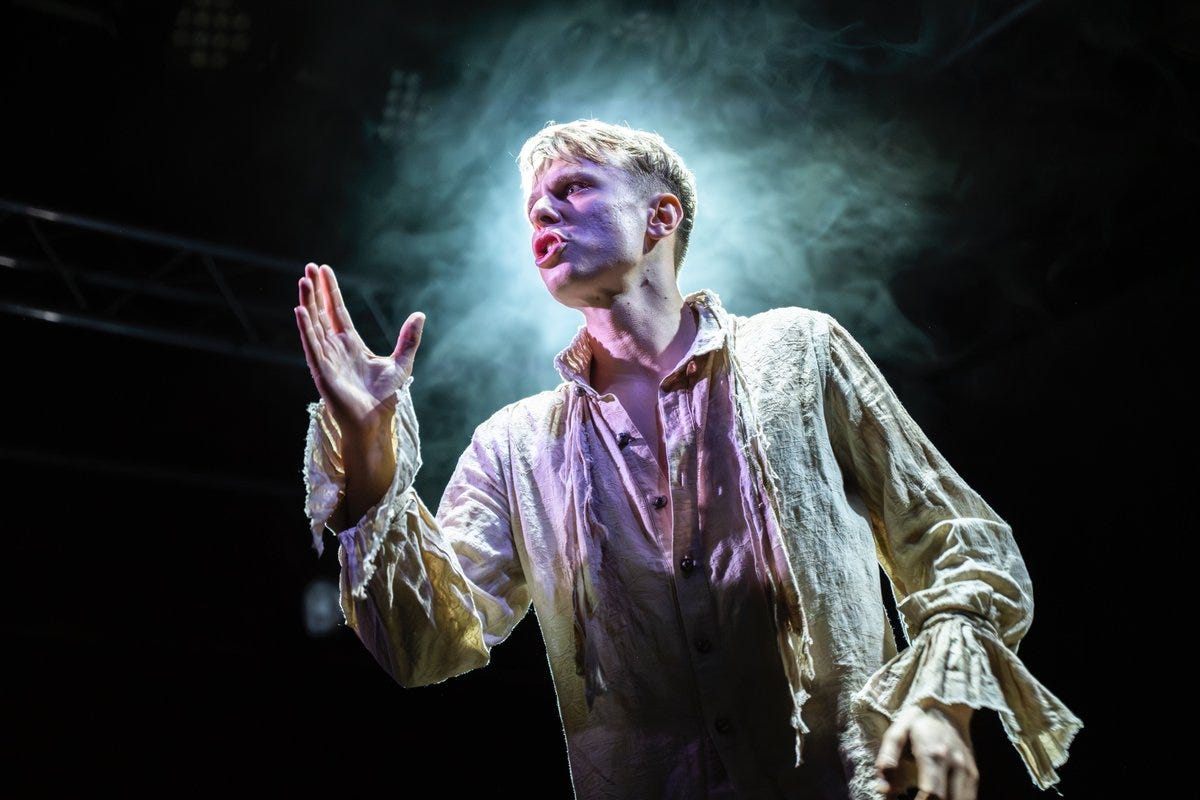
ThickSkin’s latest production, It Walks Around the House at Night, written by Tim Foley and directed by Neil Bettles, arrived at Glasgow’s Tron Theatre on Friday 16th October 2026, following a sold-out run in Edinburgh the previous weekend. Part psychological thriller and part ghost story, the 90-minute, interval-free piece plays out on a minimalist set of old wooden floorboards, accented only by a bed and a fridge to evoke a decaying manor.
From the outset, the production is lean and atmospheric. Pete Malkin’s sound design delivers perfectly timed, jarring bangs that work hand-in-hand with Joshua Pharo’s lighting and video design to keep the room on edge. The back wall projector displays a dynamic background of the manor and its floorplan map, a visual device that proves essential in helping the audience navigate the geography of the grounds. Audiences should note significant access warnings: the staging features intense blackouts and frequent, heavy flashing lights that pose a risk for anyone with photosensitive epilepsy. Accessibility was also an immediate concern in the auditorium itself; the steps leading up to the seating bank were exceptionally steep, feeling precarious for anyone with a mobility disability.
The production relies heavily on a single actor, anchored by an athletic and energetic performance from George Naylor as Joe, featuring voice work from Paul Hilton. While the script places a heavy demand on the performer, Naylor’s physical commitment drives the story forward. He covers the stage rapidly, matching his movement pace to Joe’s deteriorating state of mind. Key set pieces mirror this descent into instability: the fridge door is slammed with increasing violence as Joe’s grip on reality loosens, and at one moment glows with ominous red light to signal the supernatural. Naylor breaks the fourth wall to speak directly to the audience, establishing a clear rapport across the entire room. His comedy delivery comes out of the blue with sharp timing, offering genuine surprise and much-needed light relief against the building dread.
Oliver Baines delivers strong support as The Dancer, appearing only at the peak of Joe’s insanity. His abstract, circular choreography intertwines with Naylor’s physical performance, creating a striking piece of visual art that elevates the emotional peak of the play.
Even so, the narrative style presents structural challenges. Much of the plot relies on Joe recounting interactions and impersonating the other characters himself rather than having them acted out by a full cast. Underpinned by themes of queerness and desire, and a recurring cycle of the character stripping off and redressing on stage, this multi-character monologue begins to wear thin about three-quarters of the way through.
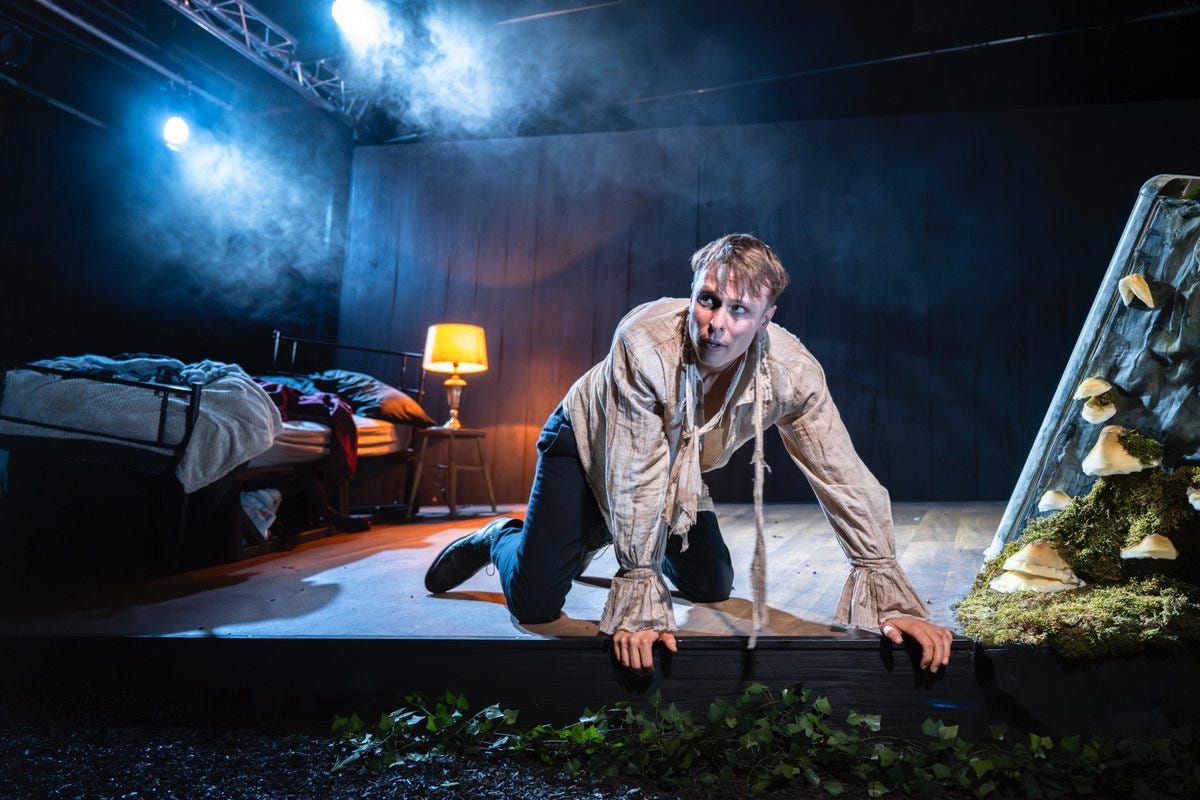
Despite those structural lulls, the production offers creative highlights. The eventual appearance of the spectre, signposted effectively through shadows and sound, is well executed, and a mid-show sequence where the main actor appears to levitate provides a genuinely striking surprise before a series of twists in the final moments. The packed, student-heavy crowd was completely invested, reacting enthusiastically to every joke and screaming at the scary crescendos. While I did not leave feeling quite as exuberant as the rest of the audience, who awarded the performance a standing ovation, there is no denying the skill and theatricality behind its best moments.
🎭